Technology and

Commercialisation Readiness Tool


Our technology and commercialisation readiness evaluation tool enables you to assess the state of your product or service development and your progress towards commercialisation while giving you the confidence of developing an action plan.

Review your innovation management processes

Identify areas for improvement

Gain useful insights

Design actions

In today’s competitive landscape, bringing innovation to market demands more than just a great idea - it requires a balanced, data-driven understanding of both technological maturity and commercial viability.


Our TRL and CRL Evaluation Tool  is a powerful innovation analytics solution that bridges this gap between technology maturity and business readiness by evaluating your project across two critical axes:


  • Technology Readiness Level (TRL)
  • Commercial Readiness Level (CRL)


Unlike traditional tools that focus solely on technology, this dual-assessment approach helps you visualise imbalances, uncover hidden risks, and align your technical progress with go-to-market strategies. The tool assesses your innovation project across nine key dimensions, each supported by five targeted statements, to produce a comprehensive and actionable report.


About the TRL and CRL Evaluation Report


By integrating gap analysis, risk heatmapping, and targeted strategic recommendations, the tool empowers startups, scaleups, and corporate innovation teams to :


  • Visualise readiness gaps across technical and commercial dimensions.
  • Identify risk levels using a colour-coded TRL-CRL heatmap.
  • Receive tailored recommendations for de-risking and accelerating commercialisation.
  • Improve investor confidence by demonstrating roadmap clarity and risk mitigation.


Key Features


Based on your responses, it calculates:


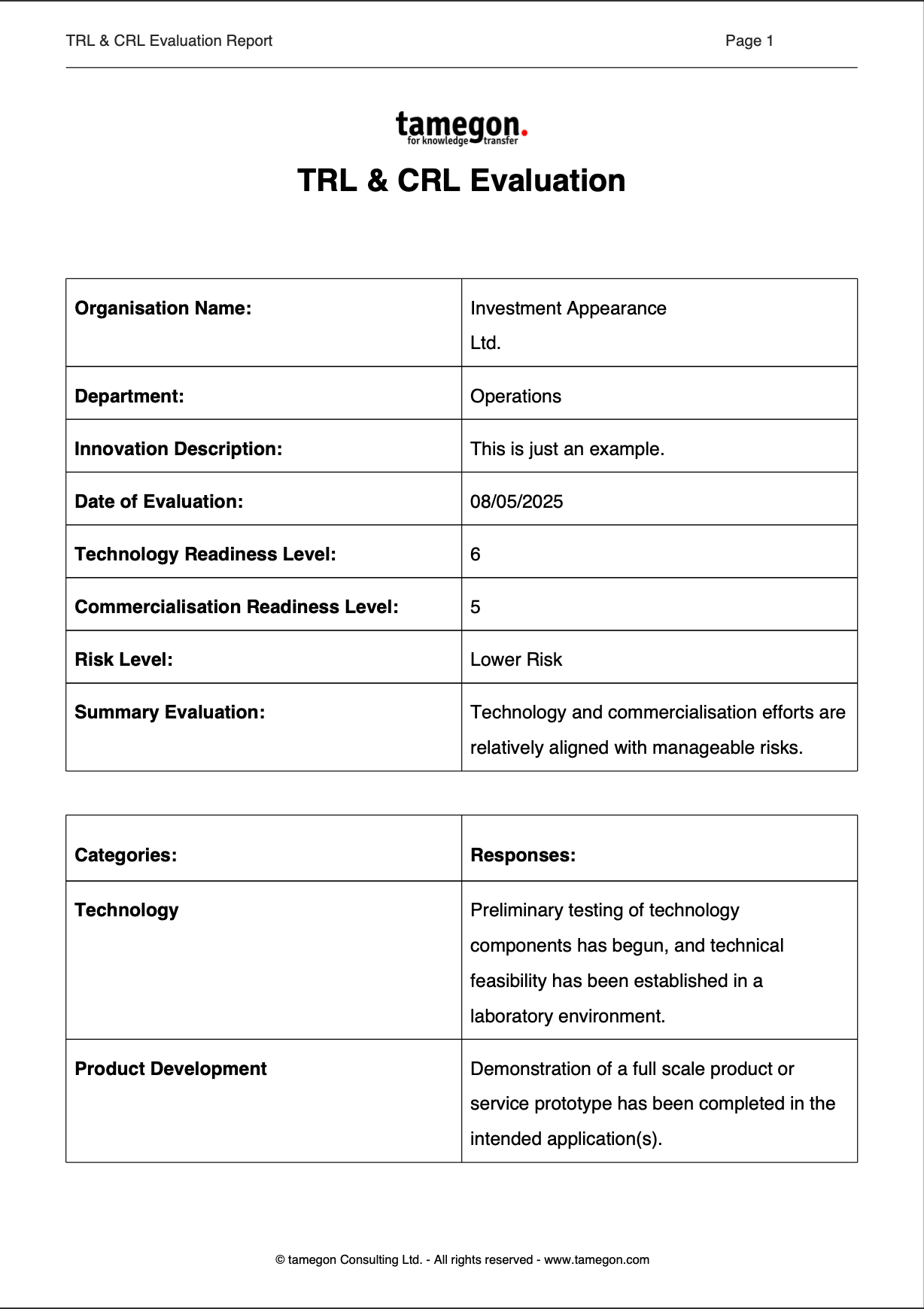
  • Your TRL and CRL scores (1-9 scale)
  • A written interpretation of your project's development status
  • A Gap Analysis reflecting whether your technology and commercial strategies are aligned
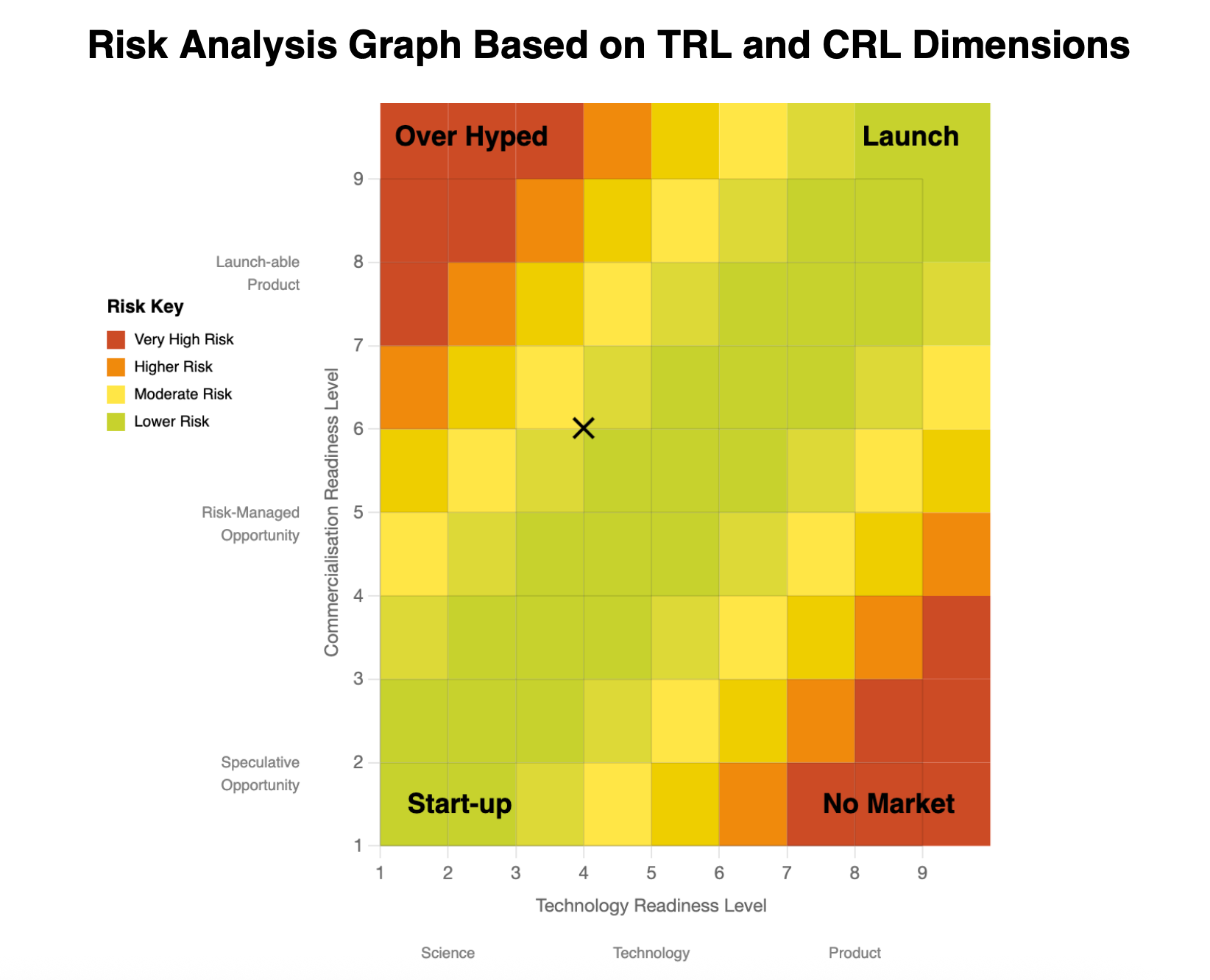
  • A risk heatmap, showing how mismatches between TRL and CRL increase market entry risk
  • Tailored recommendations to de-risk, prioritise, and accelerate progress
quotesArtboard 1 copy 2

This powerful platform delivers a data-driven evaluation to help you unlock and accelerate your organisation's innovation potential.


Whether you are a start-up, SME, scaleup, a corporate innovation team or an investor and accelerator, your personalised report will serve as a strategic roadmap - guiding you to strengthen innovation capabilities, bridge critical gaps, and maintain a competitive edge in today's fast-evolving business landscape.


How It Works


1. Complete the Survey

  • Enter your organisation name, your department and a brief summary of your product or service innovation (optional but recommended for a personalised experience).
  • Evaluate the current technical and commercial development of your product or service by rating targeted statements across nine critical dimensions.
  • Provide objective ratings to reflect your project's true stage of technical readiness (TRL) and commercial readiness (CRL).


2. Generate Your Report

  • Once the survey is completed, click “Generate Report” to review your input data.


3. Choose and Purchase Your Report

  • Select the report that best fits your needs:
Report Type Essential Report ($9.99) Strategic Report ($49.99)
TRL and CRL Evaluation (Based on responses to statements)
Summary TRL and CRL Comments
Gap Analysis (Reflection on technological and commercial maturity)
Dynamic Risk Analysis (Categorisation on risk matrix and recommendation)
Tailored Recommendations and Insights
  • Secure your report via our trusted PayPal gateway.


4. Download Your Report

  • Once your payment is processed, click "Save Report" to download your personalised PDF report.
  • Choose a location on your device to save it for easy access.


Why Choose Us?

Our tool does not just measure how advanced your technology development is - it also checks whether your business is ready to support it. By calculating your TRL and CRL levels, and mapping them on a risk heatmap, we highlight the misalignments that block commercialisation. Whether your technology is ahead of your market plan or your business case is running without a validated product, our tool flags it. It provides:


  • Your TRL and CRL scores (1-9 scale).
  • A written summary explaining what your scores mean.
  • A gap analysis showing if your technology and commercial readiness are in sync.
  • A risk heatmap, visually showing the risk level based on the TRL and CRL assessment and the gap between them.
  • Tailored recommendations based on your scores combination.
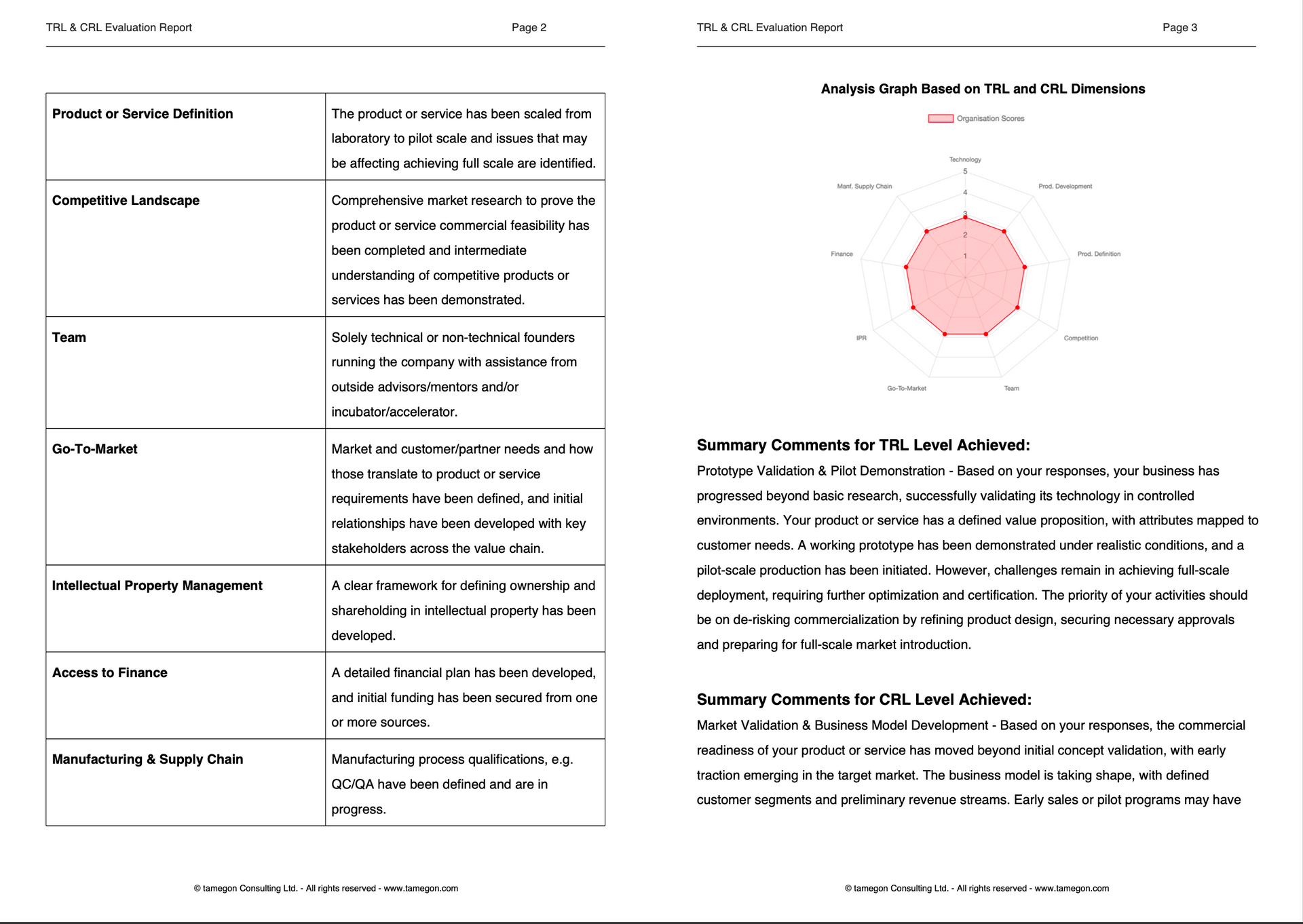
Likert Scale Survey with Spider Chart

TRL and CRL Evaluation

About Your Organisation


Do you develop or intend to develop a physical product?

Are you a start-up or early-stage company?


For each category, please select the button next to the description that best fits the status of your product or service development. This tool will determine the appropriate TRL, CRL, MRL, and IRL levels based on your answers. Once all categories have been completed, you will have the option to save a PDF report to view your TRL, CRL, MRL, and IRL scores together with personalised actions.

Technology

1. Project work is beyond basic research and technology concept has been defined.
2. Applied research has begun and practical application(s) have been identified.
3. Preliminary testing of technology components has begun, and technical feasibility has been established in a laboratory environment.
4. Initial testing of integrated product/system has been completed in a laboratory environment.
5. Laboratory scale integrated product/system demonstrates performance in the intended application(s).

Product Development

1. Initial product or service market has been defined.
2. Pilot scale product or service has been tested in the intended application(s).
3. Demonstration of a full scale product or service prototype has been completed in the intended application(s).
4. Actual product or service has been proven to work in its near final form under a representative set of expected condition(s) and environment(s).
5. Product or service is in its final form and has been operated under the full range of operating conditions and environments.

Product Or Service Definition / Design

1. One or more initial product or service hypotheses have been defined.
2. Mapping product or service attributes against customer needs has highlighted a clear value proposition.
3. The product or service has been scaled from laboratory to pilot scale and issues that may be affecting achieving full scale are identified.
4. Comprehensive customer value proposition model has been developed, including a detailed understanding of product or service design specifications, required certifications, and trade-offs.
5. Product or service final design optimisation has been completed, required certifications have been obtained, and product or service has incorporated detailed customer and product requirements.

Competitive Landscape

1. Secondary market research has been performed and basic knowledge of potential applications and competitive landscape have been identified.
2. Primary market research to prove the product or service commercial feasibility has been completed and basic understanding of competitive products or services has been demonstrated.
3. Comprehensive market research to prove the product or service commercial feasibility has been completed and intermediate understanding of competitive products or services has been demonstrated.
4. Competitive analysis to illustrate unique features and advantages of the product or service compared to competitive products or services has been completed.
5. Full and complete understanding of the competitive landscape, target application(s), competitive products or services, and market has been achieved.

Team

1. No team or company in place - single individual, no legal entity.
2. Solely technical or non-technical founders running the company with no outside assistance.
3. Solely technical or non-technical founders running the company with assistance from outside advisors/mentors and/or incubator/accelerator.
4. Balanced team with technical and business development/commercialisation experience running the company with assistance from outside advisors/mentors.
5. Balanced team with all capabilities onboard - e.g. sales, marketing, customer service, operations, etc. - running the company with assistance from outside advisors/mentors.

Go To Market

1. Initial business model and value proposition have been defined.
2. Customers/partners have been interviewed to understand their pain points/needs, and business model and value proposition have been refined based on customer/partner feedback.
3. Market and customer/partner needs and how those translate to product or service requirements have been defined, and initial relationships have been developed with key stakeholders across the value chain.
4. Partnerships have been formed with key stakeholders across the value chain, e.g. suppliers, partners, service providers, and customers.
5. Supply agreements with suppliers and partners are in place and initial purchase orders from customers have been received.

Intellectual Property Management

1. No Intellectual Property Rights (IPR) have been defined or established.
2. Preliminary considerations for protecting intellectual property have been made.
3. A clear framework for defining ownership and shareholding in intellectual property has been developed.
4. A formal assignment of intellectual property exploitation rights has been created.
5. Comprehensive contractual agreements regarding intellectual property rights have been established.

Access To Finance

1. No financial strategy is in place and no external funding sources have been identified.
2. Initial financial needs have been estimated and early-stage discussions with investors or grant providers have started.
3. A clear financial strategy has been developed, including budget forecasting and identification of relevant funding sources; seed funding or grants have been secured.
4. Institutional or private investors have been engaged, and funding agreements are in place to meet medium-term growth milestones.
5. A scalable financial model is in place, supported by a strong investor base and repeatable access to capital, ensuring long-term sustainability.

Supply Chain and Delivery Readiness

1. Potential suppliers, partners, and customers have been identified and mapped in an initial value chain analysis.
2. Relationships have been established with suppliers, partners, and service providers to understand delivery and logistics requirements.
3. Preliminary logistics and delivery planning has been developed, and partners have given input on distribution and fulfilment strategies.
4. Initial supply and delivery pathways have been tested through limited product/service rollout to early customers.
5. Initial supply and delivery pathways have been tested through limited product/service rollout to early customers.

Manufacturing Process Maturity

1. Manufacturing concepts are at an exploratory stage with basic processes not yet defined.
2. Preliminary manufacturing processes have been identified while laboratory-scale manufacturing is under way.
3. Manufacturing processes have been refined for pilot-scale while early production testing has started.
4. Production processes have been validated at pilot scale and they are close to full-scale readiness.
5. Full-scale, repeatable, and controlled processes have been implemented in production.

Design for Manufacturing and Assembly (DFM/DFA)

1. Product design has not yet considered manufacturability or assembly.
2. Initital DFM/DFA reviews have been conduscted and some limited adjustments have been made.
3. Iterative DFM/DFA improvements have been incorporated into the evolving product design.
4. Product design is mature, optimised for manufacturing including supplers' inputs.
5. Final product design fully reflects manufacturing and assmebly efficiencies.

Quality Management and Assurance

1. No formal quality control measures or systems are in place.
2. Basic quality checks are introduced at laboratory and prototype level production.
3. Quality requirements are defined with systems piloted during limited production.
4. Quality management system is fully operational and adequately supports production scaling.
5. A comprehensive Quality Assurance/ Quality Control systems are in place and are validated in full production.

Manufacturing Supply Chain Integration

1. Key components of the product, materials, and manufacturing inputs have not yet been defined with supply risks and technical needs not been fully understood yet.
2. Key suppliers for critical manufacturing inputs have been identified, and technical requirements are being communicated.
3. Suppliers are providing input on manufacturability, and some early-stage technical collaborations are underway for materials, tooling, and lead times.
4. Supplier processes are qualified or they are under evaluation with pilot-scale supply chain workflows are being tested in alignment with production requirements.
5. A fully-integrated supply chain is in place, with stable lead times, technical alignment, dual sourcing strategies (where necessary), and supply risk mitigation measures being active.

Production Facilities and Equipment Readiness

1. No dedicated manufacturing facility or equipment has been identified.
2. Potential manufacturing facilities and equipment needs have been identified.
3. Manufacturing facilities and equipment are being procured or upgraded to support pilot runs.
4. Manufacturing facilities and equipment are installed and are functional to support limited production.
5. Manufacturing facilities and equipment are fully operational and are able to support full-scale production operations.

Manufacturing Workforce Readiness

1. Workforce needs have not yet been assessed and no training plans have been developed.
2. Basic assessment of skills required has been conducted and some early discussions on workforce planning have taken place.
3. Initial workforce planning is complete and training has begun for critical roles.
4. Workforce is partially trained and deployed for pilot production.
5. Fully trained and appropriately qualified workforce is in place for full-scale operations.

Business Model Robustness

1. No clear business model or revenue logic has been put in place.
2. A conceptual business model exists but it lacks evidence or validation with the market.
3. A business model has been developed and tested with early users/customers with some visible traction.
4. A business model has been validated with measurable revenue and repeatability.
5. A scalable and defendable business model with predictable revenue streams has been developed.

Market Traction and Demand Validation

1. There is no evidence of customer discovery activities taking and there is no validated market demand.
2. Some preliminary customer interest has been indicated through surveys, interviews or focus groups.
3. Early adopters are actively using the product or service.
4. Consistent user/customer acquisition has been demonstrated, with measurable retention and actionable feedback.
5. There is evidence of strong market demand validated by growth metrics and high customer-retention rates.

Financial Readiness and Forecasting

1. There is no evidence of finacial projections or structured financial reporting.
2. Some basic cost/revenue estimates and break-even analysis and assumptions exist.
3. 12-24 month financial model has been developed with early funding secured.
4. Financial systems are put in place, cashflow forecasts are tested, realistic and are regularly updated.
5. There is evidence of a comprehensive financial strategy with audited financial statements and investor-grade forecasts.

Team Credibility and Governance

1. Team lacks necessary experience and there is no governance or advisory strauctures put in place.
2. Founders have some relevant experience with minimal external oversight.
3. Team includes core competencies, informal advisors or early board forming.
4. There is a well-rounded leadership team and active advisory board put in place.
5. There is a strong, experienced team with clear governance, investor relations, and board oversight.

Risk and Exit Strategy Awareness

1. There is no understanding of investment risks or possible exit pathways.
2. There is some basic awareness of investor expectations and potential exit options.
3. Risk factors have been identified and early planning has been conduscted for possible exit routes.
4. Risk mitigation strategies have been put in place with appropriate scenario planning.
5. There are clear exit strategies (e.g. acquisition, IPO) aligned with investor interests.

Interested in improving your innovation management activities?

We are here to help!


Contact us to discuss how our innovation survey tool can allow you to gain useful insights unlocking your innovation projects potential.

Contact Us